IMDEA Networks



IMDEA Networks wins Best Poster Award at IEEE INFOCOM for research on future 6G wireless systems
Study explores how future 6G signals behave in near-field conditions and their practical limits
23 June 2026
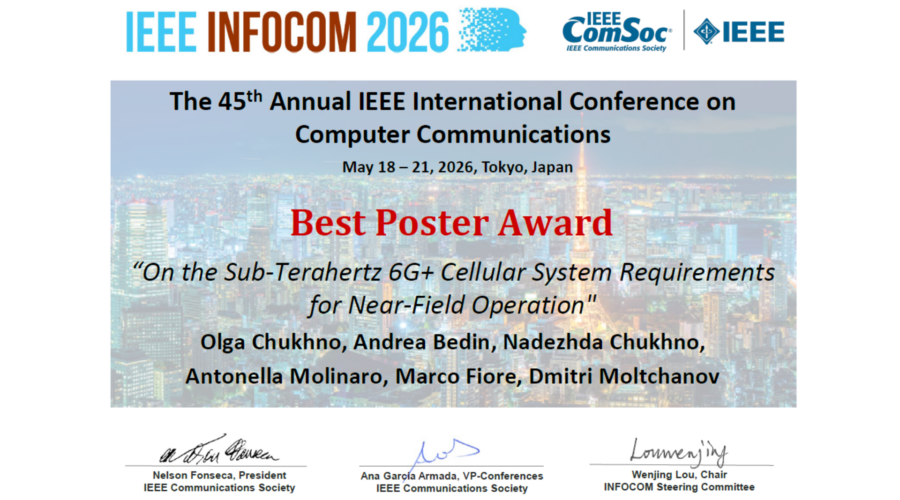
IMDEA Networks has received the Best Poster Award at the international conference IEEE INFOCOM 2026, one of the world’s most prestigious events in the field of communication networks, held this year in Tokyo, Japan. The awarded poster, titled “On the Sub-Terahertz 6G+ Cellular System Requirements for Near-Field Operation”, explores how future 6G wireless systems operating in the sub-terahertz frequency band (0.1–0.3 THz) will behave when using very large antenna arrays.
More specifically, at these frequencies, the antenna arrays required for communication become so large that a significant portion of the coverage area falls into what is known as the near-field region, where electromagnetic propagation differs from conventional long-range conditions and requires new transmission approaches.
In current wireless systems, signals are directed using a technique known as beamforming, which steers radio energy in a preferred direction, like a flashlight beam. However, in near-field scenarios, electromagnetic waves can no longer be accurately approximated as planar, and a more advanced approach called beamfocusing has been proposed. Instead of directing energy only by angle, beamfocusing aims to concentrate the signal precisely at a specific point in space, similar to the focus point of a lens, which only concentrates light at the right distance.
The study evaluates the feasibility of this approach in realistic 6G deployments. Using system-level analysis based on spectral efficiency, the researchers assess how performance is affected by user positioning accuracy and feedback delay between devices and the base station.
The results show that fully benefiting from beamfocusing would require extremely stringent conditions, including positioning errors below one millimetre and feedback delays under 0.1 milliseconds.
“These requirements, along with very low speed of users, are so demanding that they may be difficult to achieve in practical systems, raising important questions about the deployability of beamfocusing in future cellular networks,” explains Nadezda Chukhno, Post-Doc Researcher at IMDEA Networks.
“The aphorism ‘Perfect is the enemy of good’, attributed to Voltaire, perfectly describes this work,” adds Andrea Bedin, Postdoctoral Researcher at IMDEA Networks. “The study finds that traditional beamforming, although it shows worse performance in idealized conditions, remains surprisingly robust in near-field scenarios because it is less sensitive to positioning errors. As a result, it often outperforms beamfocusing in many practical cases.”
Overall, the results suggest that although beamfocusing is conceptually more advanced, it may not always represent the most practical solution for future 6G systems, where simpler approaches such as beamforming could continue to play a key role.
“A key insight from this work is that precise positioning should be seen as a performance enhancer rather than a strict requirement, since robust operation can still be achieved with simpler beamforming approaches”, says Olga Chukhno, Assistant Professor at the Mediterranea University of Reggio Calabria and Visiting Professor at IMDEA Networks.
This recognition underscores IMDEA Networks’ contribution to understanding the fundamental limits and practical design trade-offs of next-generation wireless communication systems.
Recent Comments