IMDEA Networks



16th IMDEA Networks Annual Workshop: 2026 Edition
Executive Summary from the Workshop Chairs 2026
10 June 2026
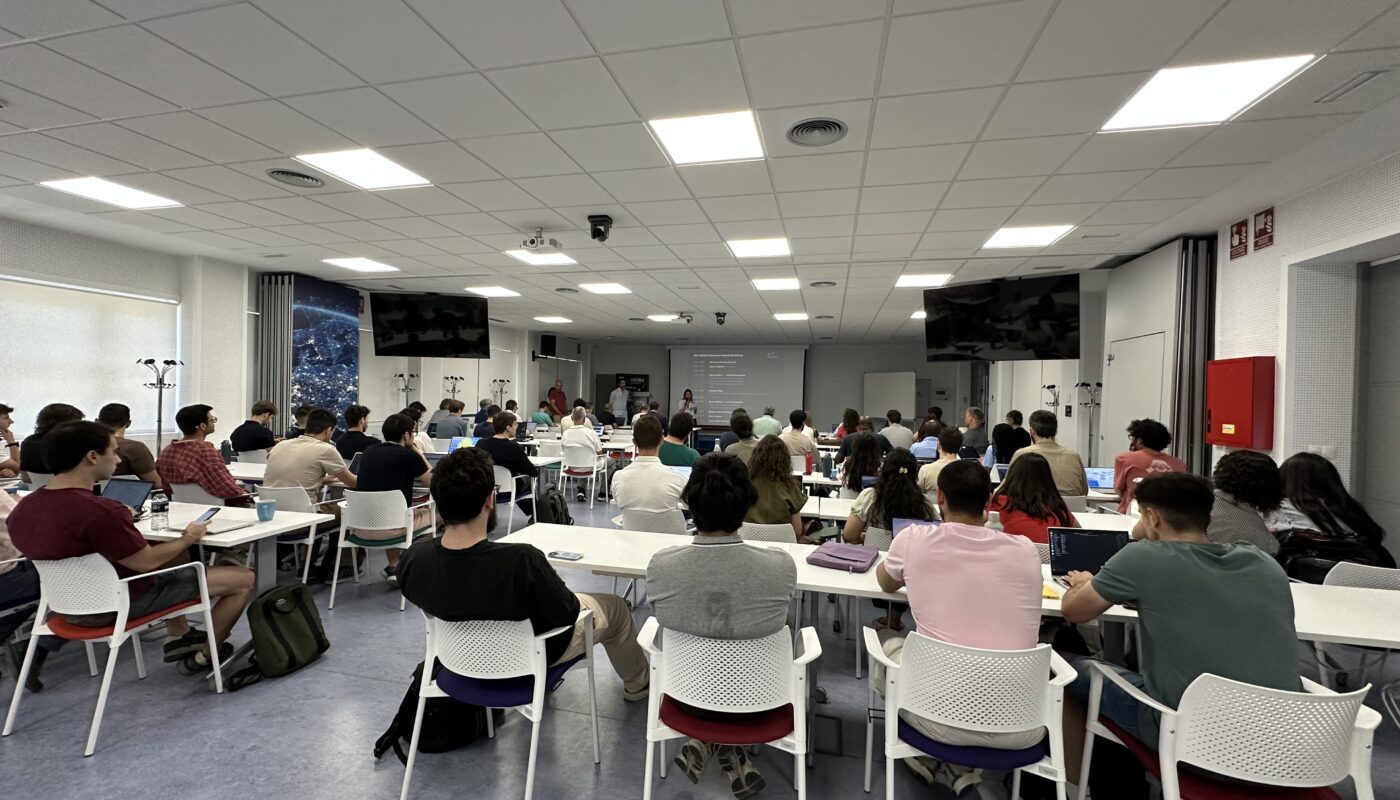
The 16th Annual IMDEA Networks Workshop took place on 27 May 2026 at the institute’s premises in Leganés, bringing together researchers, engineers, and collaborators to share recent advances and explore future directions in networking.
The workshop provided a comprehensive overview of ongoing research across the institute, combining technical presentations, lab demonstrations, and interactive discussion sessions. The event highlighted both theoretical advances and experimental platforms, reflecting IMDEA Networks’ commitment to bridging fundamental research with real-world impact.
Privacy as a lens for understanding human behavior. The workshop opened with a keynote by Pablo Serrano exploring the tension between the richness of passive network data and the privacy risks it creates. Drawing on Wi-Fi traces from the UC3M campus, the talk illustrated how spatiotemporal mobility data can serve as a powerful sensor for measuring attendance and human dynamics during crises — including the April 2025 Iberian Peninsula blackout, during which campus Wi-Fi remained operational and provided a unique window into how people reorganize under disruption. At the same time, the keynote highlighted how easily such traces enable re-identification: just four location points suffice to uniquely identify 95% of users, and defenses like MAC address randomization offer limited protection in practice. The talk concluded with synthetic trace generation using transformer-based models as a promising path toward data utility with formal privacy guarantees.
Federated learning, data ownership, and the emerging data economy. The Data Transparency Group presented work at the intersection of distributed machine learning, data economics, and AI governance — covering robustness and personalization in federated learning, pricing mechanisms for spatio-temporal data, and novel approaches to protecting ownership of data and models through frequency-domain watermarking and LLM distillation detection. A growing applied strand connects these themes to smart city challenges, including street parking optimization and urban mobility.
From SMS fraud to the evolving language of cybercrime. The Cybersecurity Group traced a research trajectory from malware analysis and chatbot security to a current focus on SMS-based fraud, where work on smishing infrastructure and user reporting systems contributed directly to Spanish legislation mandating the blocking of spoofed caller IDs. Looking ahead, the group presented CIPHER — a project aimed at understanding the evolving language of cybercriminal communities, where jargon emerges faster than detectors can learn it. By studying shared narrative structures across criminal communities and cross-lingual obfuscation patterns, the goal is to anticipate threats before they fully form.
Explainability, anomaly detection, and new computing frontiers. The Global Computing Group covered wide terrain: anomaly detection in mobile network KPIs, causally grounded counterfactual explanations using fuzzy cognitive maps, epidemic forecasting pipelines integrating behavioral mobility data, and work on distributed consensus and indirect sampling in decentralized networks. Early explorations into quantum computing for optimization and consensus rounded out a broad and active research agenda.
Next-generation wireless platforms and experimental infrastructure. The lab session showcased the experimental depth behind the institute’s wireless research. The Wireless Networking Group demonstrated RFSoC-based 6G platforms supporting over 400 MHz bandwidth and reconfigurable MIMO, alongside millimeter-level carrier-phase localization setups and a near-field 140 GHz synthetic aperture imaging system. The Pervasive Wireless Systems Group presented platforms for embedded AI on battery-free IoT devices, an open-source 5G NR testbed with over-the-air satellite link emulation, and a drone arena under construction for UAV-based optical wireless communications.
Early-career researchers and the path to independence. A new addition this year was a postdoc panel with current and past postdocs — an open conversation with PhD students about the transition to independent research, from building a recognizable research identity to navigating fellowship applications and international mobility.
A snapshot of the institute’s next generation. The worked ended with a student poster session featuring over twenty contributions from PhD students and interns. Topics spanned quantum networking, adaptive radar and mmWave sensing, in-network inference, privacy and security measurement, and applied work in smart parking, volumetric video, prediction markets, and smart farming.
The 16th edition reflected an institute working across a wide and maturing set of research fronts. The internal format encouraged direct cross-group conversation, encouraging collaboration and knowledge exchange.
Lucianna Kiffer and Claudio Fiandrino, Workshop Chairs
Recent Comments