IMDEA Networks



NEXTONIC marks a landmark 2025: ten years of open innovation and a new chapter toward 6G
The laboratory showcased major advances in immersive connectivity, including holographic communications, distributed XR collaboration, and AI-assisted network optimization through the 6G-XR project
27 April 2026
2025 has been a milestone year for the open innovation laboratory founded by Telefónica and IMDEA Networks. The laboratory celebrated its 10th anniversary in October with a high-profile event at the Espacio Fundación Telefónica, where it unveiled a new identity as NEXTONIC, adopting the slogan “Where Networks Evolve.” Throughout the year, NEXTONIC and its members—Telefónica, IMDEA Networks, Ericsson, UC3M, Capgemini Engineering, and InterDigital—achieved major technological milestones across immersive connectivity, smart urban infrastructure, quantum communications, and satellite integration, reinforcing their shared commitment to shaping the networks of the future.
A New Era of Immersive Connectivity
The Impact Day of the 6G-XR European project, held on the 28th of October at NEXTONIC’s premises in Leganés, convened over 60 participants from telecommunications, media, manufacturing, energy, and automotive sectors. Five live demonstrations showcased the project’s federated European testbed, spanning real-time holographic communication, distributed XR collaboration, and energy-aware networking. Researchers from Ericsson and Capgemini Engineering demonstrated congestion-aware holographic calling with AI-assisted rate control and automated edge node selection for multi-user XR sessions. In a further milestone, native IMS-based holographic calling—embedding holographic telepresence directly into phone dialers—was presented by MATSUKO, Telefónica, and Ericsson. Additionally, InterDigital, Telefónica, Ericsson, and Capgemini Engineering actively participated in the II Open Call of the 6G-XR project, expanding its trial portfolio alongside collaborators Nokia, Intel, WINGS ICT Solutions, and ELIG. The native IMS-based holographic calling demonstration was recognized as one of the top ten key achievements of the European SNS JU programme for 2025.
Smart Urban Infrastructure and Quantum Communications
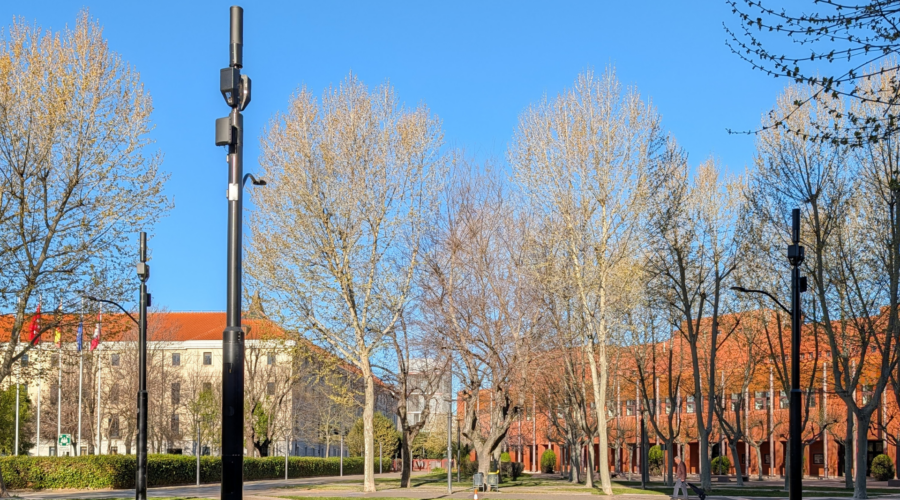
IMDEA Networks and UC3M have collaborated on the planning and deployment of the outdoor 5G radio access infrastructure for the SLICES Madrid node, funded through the UNICO I+D programme for research infrastructures. NEXTONIC will provide the core network based on Ericsson’s solution, while Telefónica has made spectrum available for the deployment. The rollout has been carried out in two phases, with an initial (experimental) smart lamppost deployed at IMDEA Networks, followed by three additional lampposts installed on the UC3M campus. Each lamppost incorporates radio units from Ericsson in mid and millimeter wave bands, as well as a Wi-Fi 7 access point from Ruckus.
In addition to advanced 5G infrastructure, IMDEA Networks also advanced the MadQuantum-CM initiative by showcasing its quantum communications testbed, now fully integrated into the NEXTONIC laboratory. This testbed enables joint validation of quantum key distribution and post-quantum security solutions, contributing to Spain’s quantum communications roadmap and reinforcing Madrid’s role in national and European quantum initiatives.
Real-World Trials: From Movistar Arena to Satellite Connectivity
NEXTONIC members also successfully brought 5G Standalone (SA) technology to real-world, high-demand environments. Telefónica, Ericsson, and UC3M deployed a portable 5G SA mmWave (26 GHz) private network at the Movistar Arena during live basketball games. Carried out under the European TrialsNet project, with the collaboration of YBVR and Prosegur Security, the trial validated three use cases: smart crowd monitoring using AI-powered cameras and LiDAR sensors, mass casualty incident coordination protocols led by UC3M, and immersive entertainment via 360-degree live streaming.
A dedicated Madrid Cluster Workshop held at NEXTONIC in September further showcased these results to institutional and industry audiences. Additionally, Ericsson and UC3M, together with Grupo Oesía, achieved a connectivity milestone by demonstrating the integration of 5G and Non-Terrestrial Networks (NTN). Using a portable 5G gNodeB connected via Eutelsat OneWeb’s LEO satellite constellation, the trial proved that continuous 5G connectivity can be maintained in remote locations lacking terrestrial infrastructure, with seamless handover between mobile and satellite access.
UC3M and Ericsson, in collaboration with Intel, have also developed a multi-technology TSN (Time Sensitive Networking) platform that combines TSN solutions based on 5G, Wi-Fi and Ethernet into a single system, a pioneer solution for the deterministic networking that is required for some industrial use ccases.
In 2026, NEXTONIC continues to serve as an international co-creation environment. Building on a decade of collaboration that has involved more than 30 national and European research projects and over 50 partner companies, all NEXTONIC members look ahead, ready to keep driving open innovation and shaping the 6G networks of the future.

Recent Comments