IMDEA Networks



IMDEA Networks welcomes students from Colegio San Bernardo for a science outreach day
The initiative, promoted by the General Directorate for Youth of the Community of Madrid, aims to encourage STEM careers through direct engagement with research at leading centers
20 May 2026
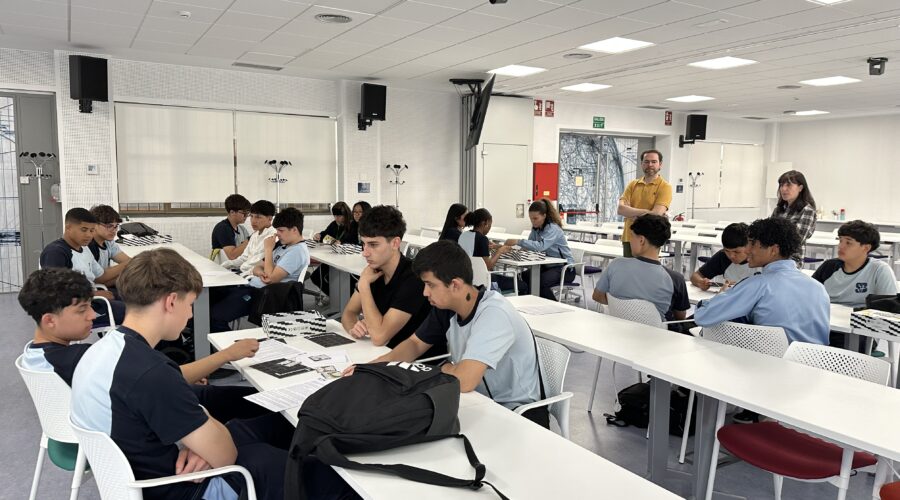
IMDEA Networks hosted 18 4th-year secondary education students from Colegio San Bernardo in Madrid today, as part of an initiative promoted by the General Directorate for Youth of the Community of Madrid to bring students closer to scientific and technological research.
The activity is part of an educational programme in which IMDEA Networks participates alongside other research centers, with the goal of inspiring STEM vocations (Science, Technology, Engineering and Mathematics) and showcasing the real-world impact of research on society.
During the visit, the group of students had the opportunity to explore several state-of-the-art laboratories at IMDEA Networks and learn about some of the institute’s most advanced research lines. The research team explained their work, main areas of study, and practical applications in everyday life.
The students toured several facilities where innovative technologies such as LiFi, millimetre-wave communications, and NEXTONIC are being developed. In the NEXTONIC laboratory, IT manager Neftalí González presented several implemented use cases and future 6G-related projects, and showed the students 5G antennas as well as the data centre (CPD).
In the millimetre-wave laboratory, engineer Anthony Sánchez demonstrated the usefulness of high-frequency signals for sensing and motion detection. Through a real-time demonstration developed by the WNG group, the students were able to observe the Doppler signature of different activities and understand practical applications such as detecting falls in elderly people or accurately determining whether a football has crossed the goal line.
The visit continued in the LiFi laboratory, where PhD student Freddy del Ángel and research engineer Fernando González explained how information can be transmitted using light, by modulating LED light at very high speeds to encode data as binary ones and zeros. They also highlighted its advantages, such as the security benefit of light not passing through walls, as well as its potential in environments where radio frequency technologies face limitations or interference, such as certain industrial or healthcare settings.
In addition, the students learned more about the world of telecommunications through the board game Conecta (part of the Teleco Renta project, funded by the Spanish Ministry of Economic Affairs and Digital Transformation and the European Union–NextGenerationEU through the UNICO-5G I+D Programme of the Recovery, Transformation and Resilience Plan), designed to test their knowledge and encourage teamwork.
Through initiatives like this, IMDEA Networks reinforces its commitment to scientific outreach and the training of future generations, bringing cutting-edge research into classrooms and showing young people the opportunities offered by careers in science and technology.
Recent Comments