IMDEA Networks


IMDEA Networks participates in the European Researchers’ Night Madrid 2026
Carlos J. Bernardos presented the potential of future mobile networks to support the prevention and management of emergency situations, as part of an activity alongside the other IMDEA Institutes and the Madrid Regional Fire and Rescue Service
28 September 2026
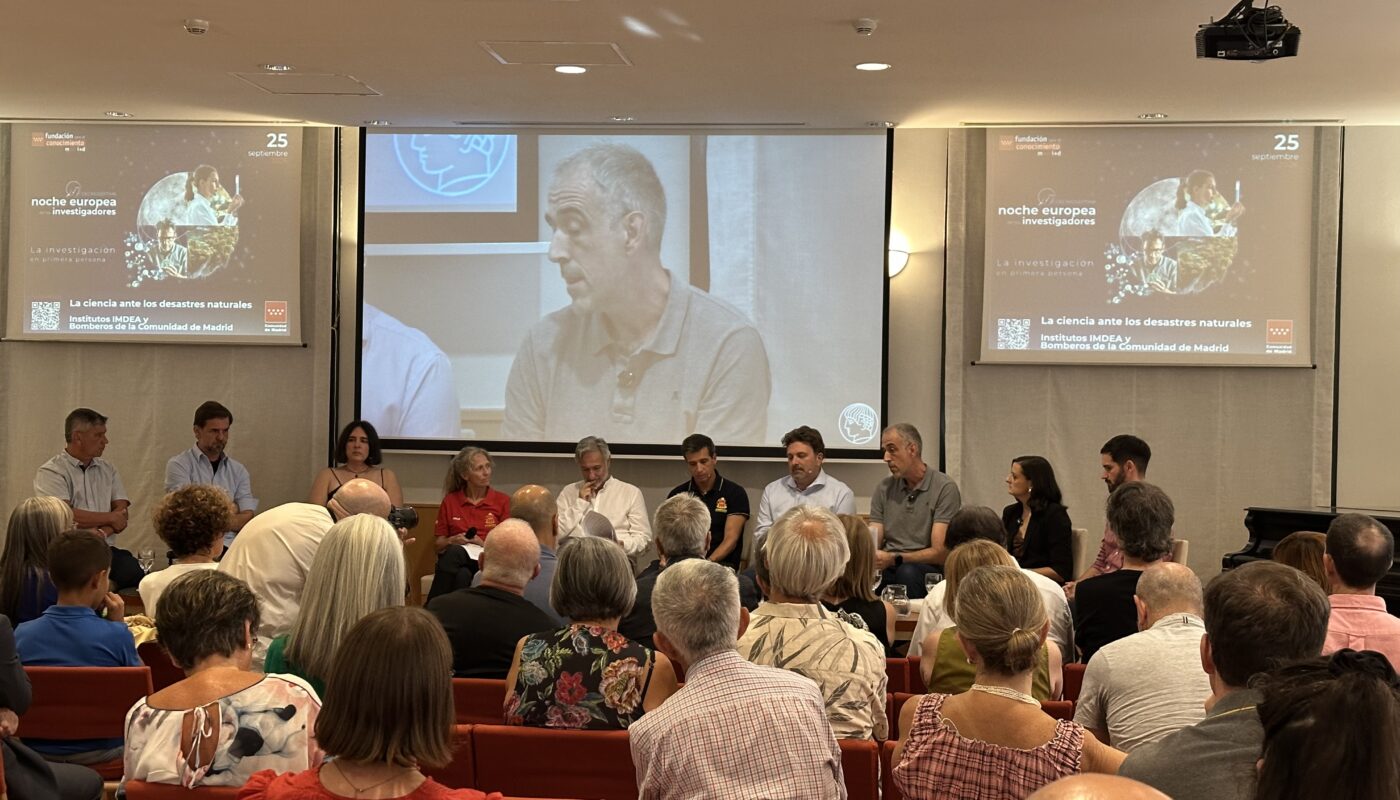
IMDEA Networks participated on 25 September in the 17th edition of the European Researchers’ Night Madrid, with an activity held at the Residencia de Estudiantes alongside the other IMDEA Institutes and professionals from the Madrid Regional Fire and Rescue Service. Coordinated by the Fundación para el Conocimiento madri+d, the event focused on the role of science and technology in preventing and managing emergencies, from fires and floods to earthquakes and accidents.
Under the title Science in the Face of Natural Disasters, researchers from the seven IMDEA Institutes — Agua, Energía, Materiales, Nanociencia, Networks, Nutrición and Software — shared their research with Annika Coll Eriksson, head of ERICAM (Emergency Response Team of the Community of Madrid), and Agustín de la Herrán Souto, head of Occupational Risks at the Madrid Regional Fire and Rescue Service. The event brought together the perspectives of those researching new technological solutions and those working on the front line of emergencies.
Representing IMDEA Networks, Carlos J. Bernardos, part-time professor and full professor at Universidad Carlos III de Madrid, presented the potential of future mobile networks to incorporate sensing and communication capabilities that could be useful in emergencies. His presentation focused on the concept of integrated sensing and communications, one of the research areas linked to the development of future 6G networks.
These technologies could make it possible to leverage existing communication infrastructures to gather information about the surrounding environment through distributed sensors. In this context, Bernardos also explained the potential of drones as a tool to support emergency response teams by providing them with a view of their surroundings and helping them carry out their work.
IMDEA Software, meanwhile, presented how artificial intelligence, territorial models and other tools can help identify risks and plan access and evacuation routes. IMDEA Materiales presented research aimed at developing safer fire-resistant materials, while IMDEA Nanociencia highlighted the potential of nanomaterials to detect gases and other compounds present in emergency situations. Other topics addressed included battery safety, power system resilience, the nutrition of professionals working under extreme conditions, and the analysis of the effects of phenomena such as floods, wildfires and droughts.
The discussion demonstrated how scientific knowledge can respond to the specific needs of emergency response teams, from improving communications and detecting hazardous substances to developing safer materials and anticipating certain risks. The participation of professionals from the Madrid Regional Fire and Rescue Service also helped relate these research areas to the challenges that arise during emergency response operations.
The activity concluded with a Q&A session, allowing the audience to explore some of the topics discussed in greater depth and learn more about the work carried out at the IMDEA Institutes and its potential applications in emergency situations.
Recent Comments