IMDEA Networks



IMDEA Networks welcomes the Mayor of Leganés
He learned first-hand about the cutting-edge research the institute is conducting in 6G networks, wireless communication, AI and cybersecurity
19 November 2025
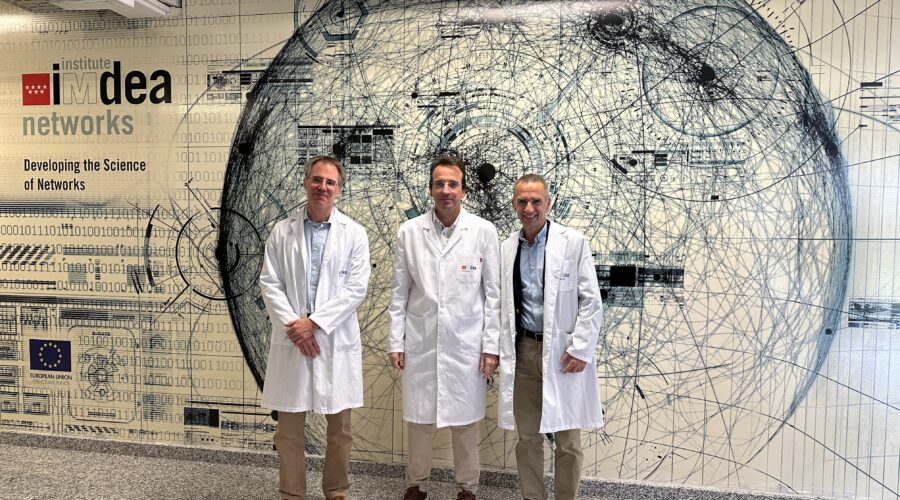
IMDEA Networks welcomed this Wednesday the Mayor of Leganés, Miguel Ángel Recuenco, who toured our state-of-the-art laboratories accompanied by our research team and the institute’s Director, Albert Banchs. Throughout the visit, he was able to discover some of the research we are doing, which has a direct impact on both industry and society.
The tour began at NEXTONIC, where its Vice President, Carlos Jesús Bernardos —Professor at UC3M and part-time researcher at IMDEA Networks— and fellow UC3M Professor Antonio de la Oliva explained to the mayor how this laboratory operates. NEXTONIC is an open ecosystem for research and innovation, where industry and academia collaborate to drive forward cutting-edge technological projects. During this stop, the team presented the latest advances and applications in communication networks, including a demonstration showing how the combination of artificial intelligence and digital twins, connected through 5G networks, enables the development of predictive tools and gesture-based robotic control systems to optimize production processes.
The visit then moved to the Data Transparency Lab, where the group led by Prof. Dr. Nikolaos Laoutaris introduced some of their most innovative research lines. Among them were a 2022 study that used mobile data to detect COVID-19 hospitalizations and generate risk maps, as well as a system designed to reduce on-street parking times.
In the LiFi Lab, Prof. Dr. Domenico Giustiniano carried out a live demonstration of optical wireless communications (OWC) for drones. In the experiment, a drone equipped with a 360° optical transmitter sent data to a receiver in the room while rotating without losing connectivity. This type of communication is resistant to noise and radio interference . In addition, the directional nature of the link ensures private communication between drones and prevents eavesdropping by external attackers.
The next stop was the IoT and Cybersecurity Lab, where researchers Narseo Vallina Rodríguez and Guillermo Suárez-Tangil showcased some of the most relevant work they have conducted in recent months to enhance the security of connected devices and protect user privacy.
The visit concluded in the millimeter-wave laboratory, where Research Director Joerg Widmer and Senior Researcher Jesús Omar Lacruz presented their experimental platforms, which are essential for developing and testing the technologies that will form part of future 6G systems. These infrastructures enable wireless systems not only to transmit data, but also to perceive and understand their environment—paving the way for applications such as intelligent elderly care, connected and safe mobility, and new services aimed at improving everyday life.
To close the visit, the Director of IMDEA Networks gave a presentation on the institute’s ongoing projects and research lines, as well as its strategic vision for the future.
Recent Comments