






IMDEA Networks

Home
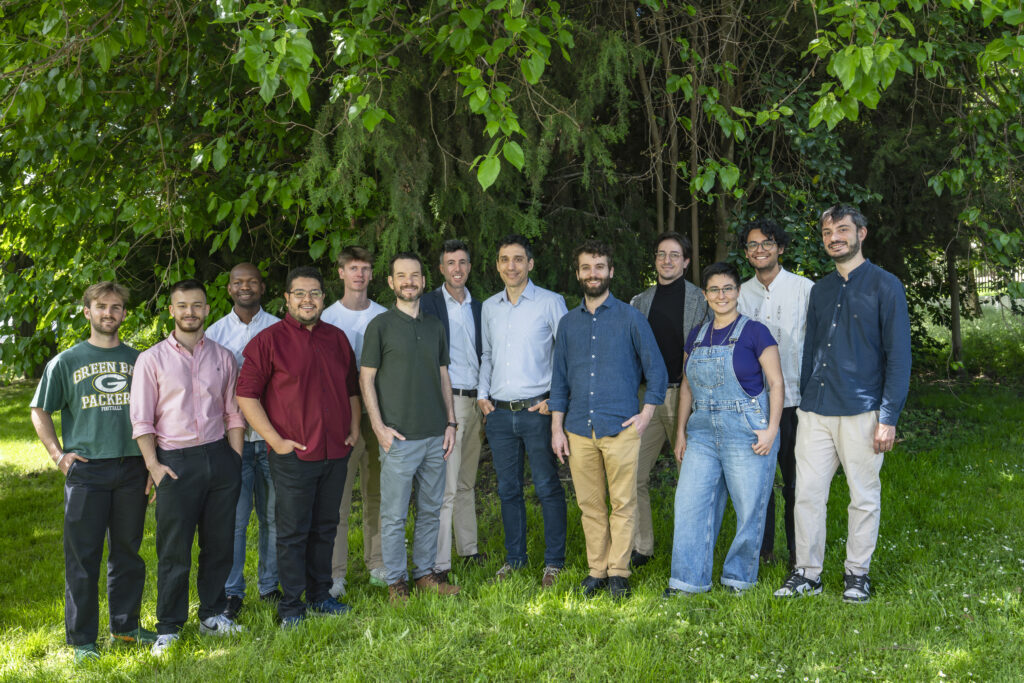
Welcome to the Pervasive Wireless Systems Group. The group is led by Dr. Domenico Giustiniano. The group investigates novel system solutions for the next generation of pervasive wireless systems. The main objective is to create impact, publishing in top system conferences, and transferring the results to the society. The current main areas of research are:
- Battery-free IoT Networks
- Unmanned Aerial Networks
- 6G Localization Systems
What’s new!

Your car’s tire sensors could be used to track you
Researchers at IMDEA Networks Institute, together with European partners, have found that tire pressure sensors in modern cars can unintentionally expose drivers to tracking. Over a ten-week study, they collected signals from more than 20,000 vehicles, revealing a hidden privacy risk and highlighting the need for stronger security measures in future vehicle sensor systems.

ENABLE-6G concludes with key innovations in AI, Privacy, and Network Efficiency
Led by IMDEA Networks Institute with partners Telefónica, NEC Europe, BluSpecs and PI Lighting, the: MAP-6G (Machine Learning-based Privacy Preserving Analytics for 6G Mobile Networks) and RISC-6G (Reconfigurable Intelligent Surfaces and Low-power Technologies for Communication and Sensing in 6G Mobile Networks), sub-projects delivered 20 innovative assets, each contributing to critical advancements in areas such as network intelligence, energy efficiency, localisation and privacy-preserving analytics. MAP- 6G was coordinated by Dr. Giustiniano Domenico, while RISC-6G was coordinated by Dr. Joerg Widmer.
ENLIGHT’EM: weaving the future of wireless communications with sustainable innovation
The European project coordinated by Domenico Giustiniano has provided pioneering results to establish the foundation for the next generation of Internet of Things networks. The project has ended in December 2023 marking a major milestone: contributing to design a new generation of wireless systems based on visible light communication (VLC) and on the low power consumption of light-emitting diodes (commonly known as LEDs) for challenging Internet of Things (IoT) scenarios.
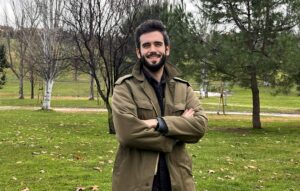
Javier Talavante wins second place in the Young Entrepreneurship Awards-Carné Joven de la Comunidad de Madrid with Sensory-FI
The spin-off, co-founded by Javier Talavante, Dayrene Frómeta, Borja Genovés and Domenico Giustiniano, has stood out not only for its technological innovation but also for its focus on environmental and social sustainability. This achievement in the Young Entrepreneurship-Young Carnet Awards reflects the positive impact that LiFi4Food can have on modern agriculture.
Team
Scientific Direction

Investigación
Research Engineering & Support
Administración
Estudiantes de doctorado externos
Former Postdocs
 |
Dr. Dayrene Frometa
Postdoctoral Researcher Current Position: Rohde & Schwarz, Spain. |
 |
Dr. Alessio Scalingi
Postdoctoral Researcher Current Position: Assistant Professor at UC3M, Spain. |
 |
Dr. Borja Genovés
Postdoctoral Researcher Current Position: MSCA Fellow at Virginia University, USA / UC3M, Spain. |
 |
Dr. Roberto Calvo
Postdoctoral Researcher Current Position: Assistant Professor at URJC, Spain |
 |
Dr. Maurizio Rea
Postdoctoral Researcher Current Position: Project Manager at ICT consulting, Italy. |
 |
Dr. Danilo de Donno
Postdoctoral Researcher Current Position: Senior Wireless System Engineer at Huawei, Italy |
Alumni
 |
Stavros Eleftherakis
PhD student Current Position: Research Engineer at IMDEA Networks, Spain. |
 |
Yago Lizarribar
PhD student Current Position: Scientific Project Manager en CYD Campus, Switzerland. |
|
Dayrene Frometa
PhD student Current Position: Rohde & Schwarz, Spain. |
 |
Alessio Scalingi
PhD student Current Position: Assistant Professor at UC3M, Spain. |
|
Roberto Calvo
PhD student Current Position: Assistant Professor at URJC, Spain. |
|
Maurizio Rea
PhD student Current Position: Project Manager at ICT consulting, Italy. |
 |
Ander Galisteo
PhD student Current Position: Dojo Five: The Embedded Experts, St. Paul, Minnesota, USA. |
 |
Aymen Fakhreddine
PhD student Current Position: Senior Researcher, University of Klagenfurt, Austria. |
 |
Qing Wang
PhD student Current Position: Assistant Professor at TU Delft, Netherlands. |
Projects

SpecX
Red Doctoral sobre Analíticas del Espectro como un Servicio
Financiado por: Unión Europea (Horizonte Europa)

ANT
Sistemas y Aplicaciones de IA Embebidos
Financiado por: Unión Europea (Horizonte Europa)

TUCAN6-CM
Tecnologías para la detección y comunicación en redes 6G
Financiado por: Comunidad de Madrid
S
SUNRISE
Sistemas ópticos no tripulados seguros
Financiado por: Technology Innovation Institute (TII)

GERMINAL
Conectividad. Habilitación del terminal híbrido NAV COM de próxima generación
Financiado por: Agencia de la Unión Europea para el Programa Espacial (EUSPA)
Proyectos anteriores
6th SENSE (ELSA)
Análisis basado en detección y ubicación 6G
RISC-6G
Superficies inteligentes reconfigurables y tecnologías de bajo consumo para comunicación y detección en redes móviles 6G
MAP-6G
Analíticas para la preservación de la privacidad basadas en aprendizaje automático para redes móviles 6G
SOMIRO
Robótica 'soft' en miniatura
ENLIGHT’EM
Red europea de formación en sistemas IoT de comunicación por luz visible de bajo consumo
ARMASUISSE - AerialSensing
Detección de actividad de intrusos desde el cielo impulsada por IA
TAPIR-CM
Técnicas Avanzadas para Potenciar la Inteligencia de las Redes 5G
Armasuisse-BigLocator
Posicionamiento basado en Big Data de transmisores no autorizados
CONTACT-CM
Seguimiento de contactos con redes 5G y más allá
LOCUS
LOCalización y análisis a demanda integrados en el ecosistema 5G, para aplicaciones Verticales Ubicuas
Armasuisse - TecLoch
Clasificación Tecnológica y Localización de Anomalías en el Espectro
PinPoint 5G+
Posicionamiento Preciso, Ubicuo y de Baja Latencia para la Innovación en redes 5G y Posteriores
MYP-SOCRATES
Detección y ubicación colaborativa a gran escala de amenazas en el espacio electromagnético
Armasuisse - CompPos
Armasuisse - SPECTRUMCOP PROGRAM: LOCATE IT
Armasuisse- SPECTRUMCOP PROGRAM: SpecScale
Tecnologías para la detección colaborativa de anomalías en el espectro
Armasuisse - SPECTRUMCOP PROGRAM: MONTEBIANCO
Tecnologías para la detección colaborativa de anomalías en el espectro
Location-aware MAC scheduling in Mobile and Dense Networks
Programación MAC con reconocimiento de ubicación en redes móviles y densas
Armasuisse - SPECTRUMCOP PROGRAM: SPECTRUMCOP II
Tecnologías para la detección colaborativa de anomalías en el espectro
Flex5Gware
Plataformas de hardware/software flexibles y eficientes para elementos y dispositivos de redes 5G
Armasuisse - SPECTRUMCOP PROGRAM: SPECTRUMCOP I
Tecnologías para la detección colaborativa de anomalías en el espectro
Armasuisse - MATISSE
Sistemas sensores ubicuos del espectro y la localización móvil
DESPLIEGUE DE REDES INALÁMBRICAS Y LOCALIZACIÓN EN INTERIORES EN BASE A Wi-Fi
OPPORTUNISTIC TIMING SIGNALS FOR PERVASIVE MOBILE LOCATION
SWARMIX
Interacciones sinérgicas en enjambres de agentes heterogéneos
Publications
From 5G Single-Cell Signals to Pervasive Smartphone Positioning: A Real-World Study
Stavros Eleftherakis, Domenico Giustiniano, Yuxin Zhao, Xiaolin Jiang, Gustav Lindmark, Fredrik Gunnarsson
Mediterranean Artificial Intelligence and Networking. Palermo, Italy. Julio 2026
Soil Moisture Sensing through Phase Measurements in Analog Backscatter Systems
Vincenzo Gentile, Domenico Giustiniano, Dayrene Frómeta
IEEE International Symposium on a World of Wireless, Mobile and Multimedia Networks. Bologna, Italy. Junio 2026
From 5G Single-Cell Signals to Pervasive Smartphone Positioning: A Real-World Study
Stavros Eleftherakis, Domenico Giustiniano, Yuxin Zhao, Xiaolin Jiang, Gustav Lindmark, Fredrik Gunnarsson
Mediterranean Artificial Intelligence and Networking Conference. Palermo, Italy. Mayo 2026
Blind 5G NR LEO Initial Access Receiver
Chen Jaminon-De Roeck, Otim Timothy, Giuseppe Santaromita, Domenico Giustiniano
EuCNC & 6G Summit. Malaga, Spain. Abril 2026
Can’t Hide Your Stride: Inferring Car Movement Patterns from Passive TPMS Measurements
Yago Lizarribar, Alessio Scalingi, Domenico Giustiniano, Pedro Miguel Sánchez Sánchez, Roberto Calvo-Palomino, Gerome Bovet, Vincent Lenders
IEEE Wireless On-demand Network systems and Services Conference. Switzerland. Marzo 2026
On the Scalability of Access and Mobility Management Function: The Localization Management Function Use Case
Domenico Scotece, Giuseppe Santaromita, Claudio Fiandrino, Luca Foschini, Domenico Giustiniano
IEEE Transactions on Network and Service Management. Febrero 2026
Accelerating Emergency Location and Response in 5G and Beyond Networks
Alessio Scalingi, Domenico Giustiniano, Francesco Pigato
Workshop on Mobile Computing Systems and Applications. Atlanta, USA. Febrero 2026
A Unified Hybrid Terminal for Augmented Positioning
Francesco Pigato, Giuseppe Santaromita, Timothy Otim, Jon Lejardi, Domenico Giustiniano
Winter School on AI for 6G Communications. C. de Pérez del Toro, 1, 35002 Las Palmas de Gran Canaria, Las Palmas, Spain. Enero 2026
Sustainable Spectrum Crowdsensing
Yijing Zeng, Bangya Liu, Yilong Li, Domenico Giustiniano, Suman Banerjee
IEEE-ACM Transactions on Networking. 10.1109/TON.2026.3650867. Enero 2026
5G TN Tests for a Unified Hybrid Terminal for Augmented Positioning (Poster)
Francesco Pigato, Giuseppe Santaromita, Timothy Otim, Domenico Giustiniano
Winter School on AI for 6G Communications. Las Palmas de Gran Canaria. Enero 2026
- 1
- 2
- 3
- …
- 13
- arrow_forward_ios
Infrastructure
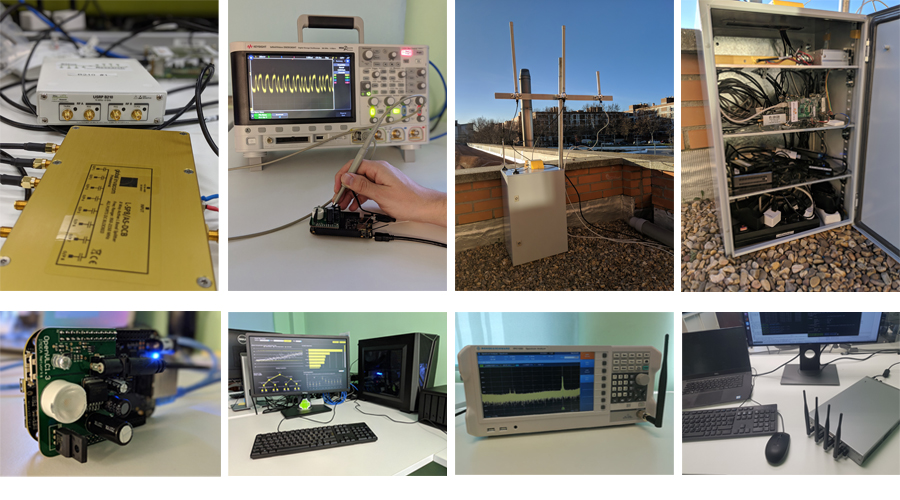
The hardware and infrastructure support end-to-end experimental research in wireless systems, spanning radio prototyping, localization, battery-free IoT, LiFi/visible-light communication, cellular experimentation, and large-scale data collection.
On the experimental platforms, the lab has SDR and RF measurement platforms built around multiple Ettus USRPs: 8 USRP N310, 1 USRP N300, 4 USRP B210, 2 USRP B200mini, 1 USRP N210 and 1 NVIDIA Orin AGX, together with synchronization and timing hardware such as OctoClock-G CDA-2990, SecureSync 2400, White Rabbit, GPSDO boards, and active GPS antennas. It is further equipped with 2x Holybro X500 Unmanned Aerial Vehicles. This infrastructure is suitable for distributed radio experiments, spectrum sensing, indoor and outdoor localization, timing-sensitive testbeds, and 5G/6G prototyping.
The RF instrumentation includes a Keysight PZ2100A + PZ2120A source / measure unit, a Keysight DSOX4024A oscilloscope, an Agilent 3000 X-series oscilloscope, a 5 kHz to 3 GHz spectrum analyzer, 2 Saleae logic analyzers, a NanoVNA V2, Analog Discovery 2, Analog Discovery 3 Pro, and a Korad 30V/5A bench power supply. Together, these tools support signal debugging, hardware validation, embedded development, and fast prototyping of communication systems.
For rapid prototyping and experimental integration, the lab also includes a Bambu Lab H2D 3D printer with a 350 × 320 × 325 mm³ build volume and 5 μm optical motion calibration. This enables fast fabrication of custom enclosures, mounts, fixtures, sensor holders, and mechanical components for wireless, optical, and embedded system experiments.
For cellular and device-based experimentation, the available hardware includes a Quectel RM521F-GL 5G module, OnePlus 8, Google Pixel 7, and OPPO Reno 2 5G smartphones, plus other embedded and networking devices Raspberry Pi 4, Google Coral, rugged laptop platforms, and NUC systems. These platforms are well suited for mobile measurements, protocol testing, and real-world wireless evaluation.
For battery-free and sustainable IoT research, the inventory includes 50 battery-free IoT devices and 2 Powercast RF harvesters, directly supporting work on energy-harvesting communications and low-power sensing.
For visible-light communication and optical experimentation, the lab includes OpenBuilds Acro Systems, LC shutters, X-FOS and FOS optical components, a laser ranger, light meter/datalogger, high-power Tridonic LEDs, and related optical hardware.
The compute and storage infrastructure significantly strengthens this setup. The group has a 15 TB NAS for replicated storage, multiple lab and datacenter servers, and both CPU- and GPU-oriented systems for experimentation, analysis, and AI workloads. This infrastructure is both for building wireless experiments and storing traces, processing data, running software stacks, and training or deploying machine learning models. The compute infrastructure provides a combination of experiment control, high-speed processing, large-scale storage, and AI acceleration. It supports OpenAirInterface-based 6G experimentation, SDR processing, indoor core-network and UE emulation, localization pipelines, and data-intensive wireless measurement studies. The available systems include GPU-equipped machines for deep-learning workloads, high-memory servers for shared compute and large experimental datasets, and replicated storage for long-term trace and file management. The infrastructure also includes modern multi-core servers with high-speed 10 Gbps and 100 Gbps connectivity, enabling fast transfer of large datasets. In addition, the presence of A100-class GPU resources makes the platform suitable for large-scale AI applications, signal-processing pipelines, MATLAB-based analysis, and AI-enhanced wireless systems research.
Contact
- Group leader: Domenico Giustiniano
- Contact: Please use the form «Get Involved» for research, collaboration, student, or media inquiries.
- Phone: +34 914 816 970
- Fax: 3491481696
Office & Postal Address
- IMDEA Networks Institute
- Avda. del Mar Mediterraneo, 22
- 28918 Leganes (Madrid)
- SPAIN