IMDEA Networks



About
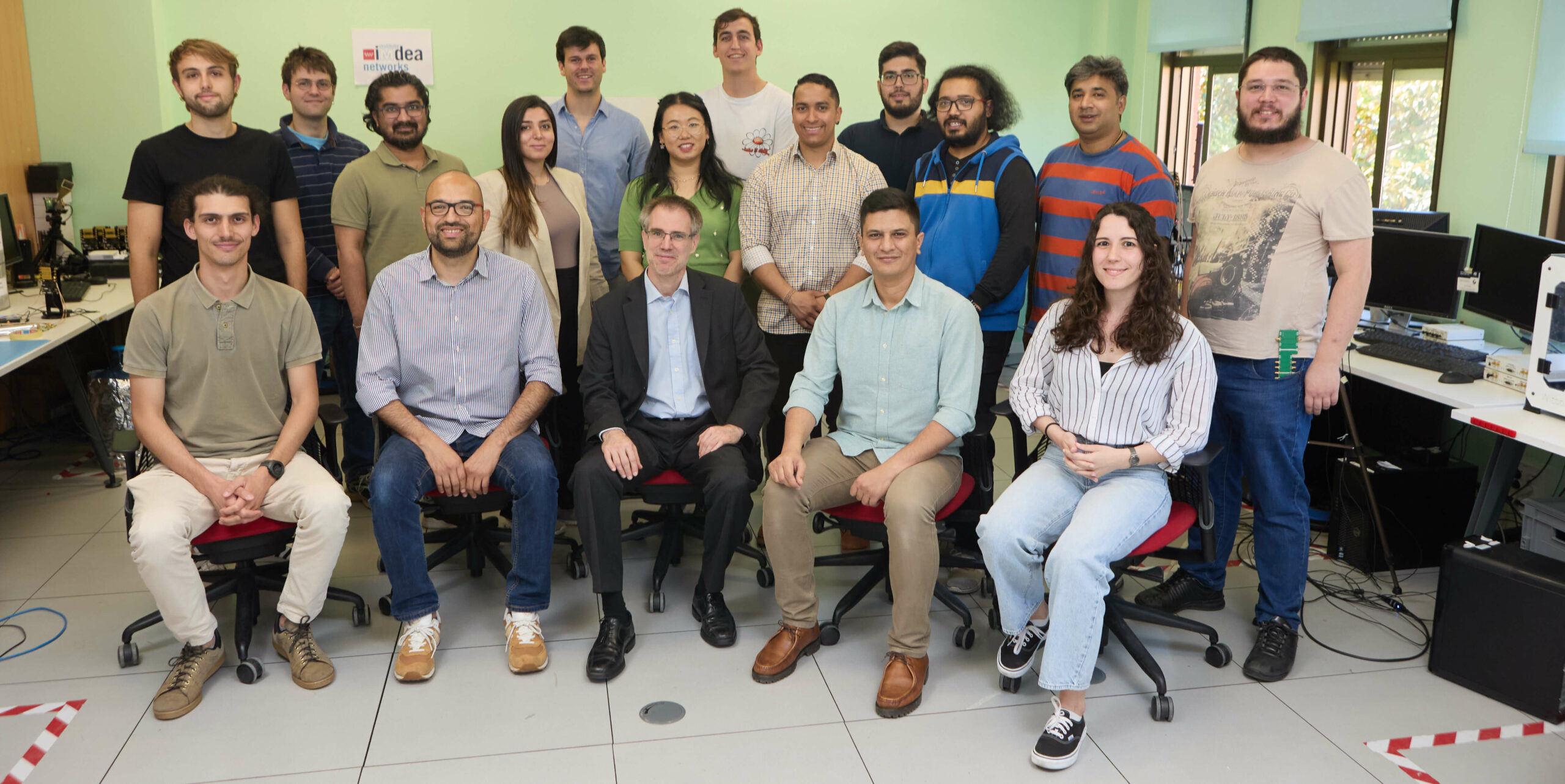
Welcome to the Wireless Networking Group site. WNG performs research on all aspects wireless networking and communication. We specifically target experimentation in testbeds in addition to analysis and simulation. Some of our focus areas are:
- Millimiter-wave networking and extremely high frequency communication
- Interference management and coordination mechanisms
- Network coding
- Mobile network resource and traffic optimization
- Wireless transport protocols
What’s new!

Best Poster Award at IEEE INFOCOM 2026
Our work “On the Sub-Terahertz 6G+ Cellular System Requirements for Near-Field Operation” has received the Best Poster Award at IEEE INFOCOM 2026 for its research on near-field communications in future 6G systems. The study explores the practical limits of beamfocusing in the sub-terahertz band and highlights the challenges associated with its real-world deployment. More info.

Best Demo Award Runner-Up at MobiSys 2026
Our demonstration, “Demo: ISAC Real-Time Experimentation Platform,” received the Best Demo Award Runner-Up at MobiSys 2026. It introduces a cross-layer hardware-software architecture that enables the real-time extraction and streaming of channel estimates for sensing while preserving a 5G-like communication link. As a proof of concept, the micro-Doppler signatures of moving targets are extracted and visualized in real time.
Distinguished Paper Award at IEEE ICCSPA 2026
Our work “Physical Limitations to the Accuracy of Range-Based Localization and Sensing” has received the distinguished paper award at IEEE ICCSPA 2026. The work highlights the metrology issues related with high precision wireless sensing, and provides quantitative and qualitative estimates of the magnitude and nature of said issues.

Mario Gerla Best Paper Award at MAIN 2026
Our work introducing “NeuroFlexMLP: a Low Complexity MLP Architecture for Long-Term Time Series Forecasting” has received the Mario Gerla Best Paper Award at MAIN 2026 for its research on efficient time series forecasting. The study demonstrates how a lightweight architecture combining a linear backbone with non-linear residual blocks can match or outperform complex transformers, highlighting its practical viability for resource-constrained deployments.